DE

EN

LT

LV

EE
RUS

PL
Beesproducts.eu
Bees, Bee Products and Health
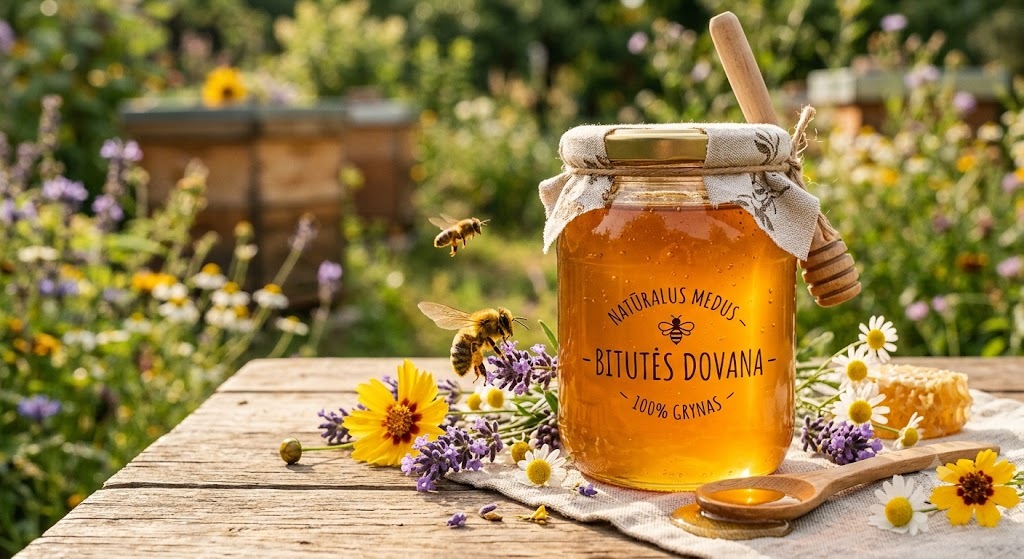
Honey is a natural sweet liquid produced by worker bees from plant nectar or sweet secretions found on tree leaves, needles, or twigs (honeydew).
What is its purpose in the bee world? For bees, honey is the primary source of carbohydrates (energy) and food reserves, enabling the colony to survive the winter and feed the brood in early pavasaris (spring) when there are no blossoms in nature yet.
What is honey made of? It is a highly concentrated carbohydrate solution. It contains about 80% natural sugars (mostly fructose and glucose) and only about 17–18% water. The remaining percentage consists of an incredibly valuable cocktail of biologically active substances: vitamins (B group, C), minerals (iron, potassium, calcium, magnesium), enzymes (invertase, diastase), organic acids, and powerful antioxidants (polyphenols).
Since ancient times, honey has been valued as a natural medicine (the foundation of apitherapy). Its benefits to the body are scientifically proven:
Antibacterial and anti-inflammatory effects: The enzyme glucose oxidase in honey releases small amounts of hydrogen peroxide, which destroys bacteria. Therefore, honey helps treat throat infections, soothes coughs, and is even used to topically treat wounds or burns.
Immune system boost: It is rich in antioxidants that fight free radicals, strengthening the body's resistance to infections and slowing down cellular aging.
Digestive system support: Honey acts as a mild prebiotic—it feeds good gut bacteria, helps regulate acidity, and soothes the stomach lining.
Quick energy source: Because the glucose and fructose in honey are already broken down by bee enzymes, the body absorbs them instantly without putting a strain on the pancreas. This makes it an excellent energy boost after physical or mental exhaustion.
Honey production is an incredibly coordinated, team effort by bees, consisting of several stages:
Nectar gathering: A scout bee finds flowering plants and informs the colony. Forager bees suck up the nectar using a special proboscis into their second stomach (the honey stomach). To fill this stomach, a bee must visit between 50 and 1500 flowers.
In-flight fermentation: Even during the flight back to the hive, the bee secretes enzymes from its glands into the nectar, starting to break down complex sugars (sucrose) into simple ones (glucose and fructose).
Transfer and fanning: In the hive, the forager regurgitates the nectar and passes it to the worker bees ("receivers"). They repeatedly draw the nectar droplets into their stomachs and push them back out, further enriching it with enzymes. The droplets are then deposited into the honeycombs. Since nectar contains up to 80% water, the bees fan their wings intensively, creating an airflow that evaporates the excess moisture until less than 20% water remains.
Capping: Once the honey thickens and matures, the bees seal (cap) the honeycomb cells with wax lids. This is the signal to the beekeeper that the honey is ready to be harvested.
Immortal food: Honey is the only food product that never spoils if properly sealed. In the ancient Egyptian pyramids (which are over 3000 years old), archaeologists found pots of honey—it was completely edible and had not lost its properties.
Liquid gold and currency: In ancient Rome and Egypt, honey was so valuable that it could be used to pay taxes. The Romans used honey to treat wounded soldiers on the battlefield.
The term "Honeymoon": This expression comes from an ancient tradition where newlyweds had to drink mead (an alcoholic honey beverage) every day for the first month after their wedding to ensure the marriage would be sweet, fertile, and result in healthy offspring.
The taste, color, and properties of honey directly depend on which plants the bees collected the nectar from:
Spring honey (Pavasarinis medus): The first honey of the season, collected from dandelions, orchard blossoms (apple, pear), and sallows. It is light yellow, has a mild, pleasant taste, and crystallizes (hardens) very quickly (within a couple of weeks) due to its high glucose content.
Polyfloral / Meadow honey (Daugiažiedis medus): The classic, most popular honey, collected from dozens of different field and forest flowers. Its taste is balanced and aromatic, and its color ranges from yellow to golden. It is a true multi-vitamin bomb, as it combines the properties of various plants.
Buckwheat honey (Grikių medus): Dark brown, sometimes even with a reddish or black tint. It has a very strong, specific, sharp aroma and taste (it can cause a slight tickle in the throat). This variety stands out for having the highest iron and protein content, making it highly recommended for those with anemia or looking to boost blood health.
Rapeseed honey (Rapsų medus): Very light, almost white or creamy when it solidifies. Its scent is mild, and the taste is sweet without any acidity. It contains few organic acids, making it perfect for people with high stomach acidity. It solidifies extremely fast, sometimes within just a few days.
Linden / Lime blossom honey (Liepų medus): Light yellow with a greenish tint, smelling of linden blossoms. This is the best weapon against colds, flu, and fever, as it possesses the strongest diaphoretic (sweat-inducing) and antipyretic (fever-reducing) effects.
Honeydew honey (Lipčiaus medus): A unique honey that bees produce not from floral nectar, but from sweet secretions on tree leaves or needles. It is dark, viscous, has a resinous taste, and contains several times more minerals than floral honey.
This honey is exceptional not only in Lithuania but across all of Europe. The European Commission granted it the Protected Designation of Origin (PDO) status, which serves as a premium guarantee of quality and origin.
| Feature | Description |
| Geographical Uniqueness | This was the first joint product of two countries (Lithuania and Poland) to be included in this prestigious EU register. It is harvested within a strictly defined territory of the Neman River basin—specifically the Lazdijai district and the Seinai and Suvalkai counties. |
| Natural Environment | In this border region, the land was historically less fertile, which prevented the development of aggressive industrial agriculture. As a result, ancient, pristine natural meadows untouched by human activity have survived, where a unique blend of European and Eurasian flora thrives. |
| Botanically Pure Polyfloral | This is an exclusively polyfloral nectar honey. Strict PDO regulations require that the pollen content of cultivated crops (such as rapeseed or buckwheat) cannot exceed 5%. The honey is gathered solely from natural, wild flora. |
| Appearance and Taste | Its color varies from dark yellow to dark golden. The taste is rich and deep, featuring a slight bitterness provided by wild meadow plants, and a rich aroma that is impossible to mistake for honey coming from industrial fields. |